
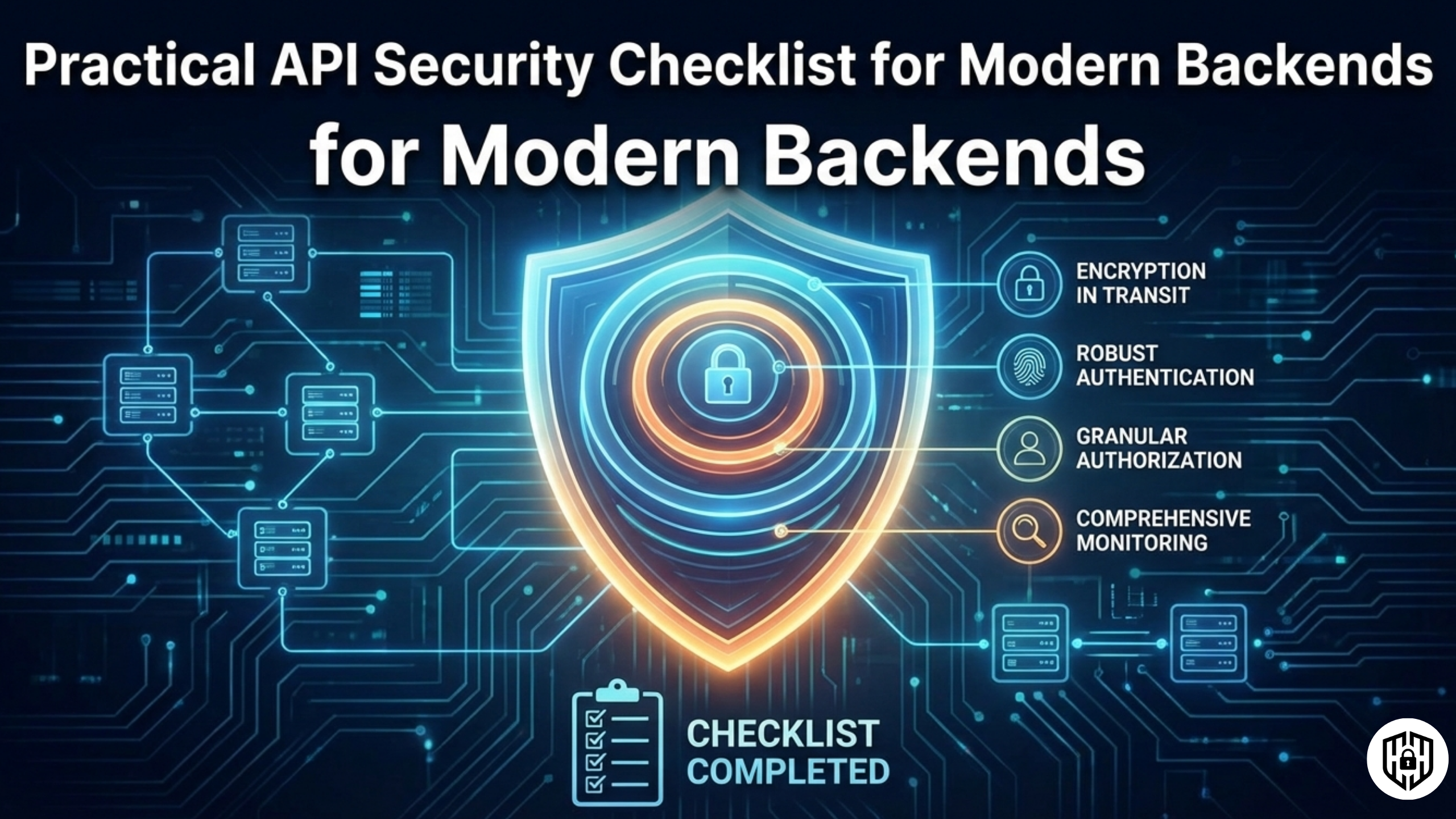
Why APIs Are the New Security Battleground
APIs power modern applications. They're the connective tissue between frontend and backend, between microservices, and between your platform and third-party integrations.
However, APIs are also a prime attack surface. According to recent security research, nearly 33% of API services in production have at least one critical vulnerability. The stakes are high: a single compromised API can expose customer data, enable lateral movement into internal systems, or allow attackers to manipulate business logic.
Unlike traditional web application security, API threats are often silent. There's no user interface to tamper with—just malicious requests that slip past weak authentication, find authorization gaps, and execute unintended actions. This guide provides a battle-tested, actionable checklist to harden both REST and GraphQL APIs before threats find your weaknesses.
1. Authentication & Credential Management
Authentication is the first gate. If attackers bypass it, everything downstream falls.
Enforce OAuth 2.0 and OpenID Connect
OAuth 2.0 is the industry standard for delegated access. It eliminates password sharing and provides granular scope-based permissions. Use OpenID Connect on top of OAuth 2.0 for identity verification. For user-facing applications, this prevents account takeover; for third-party integrations, it prevents wholesale credential exposure.
API Key Management & Rotation
For service-to-service communication, API keys are simpler than OAuth but demand rigorous rotation and revocation policies. Never hardcode keys in source code; use environment variables or secrets management systems.
2. Authorization & Access Control
Authentication answers "Who are you?" Authorization answers "What can you do?" Weak authorization is the top attack vector on APIs.
Implement Role-Based Access Control (RBAC)
Assign permissions based on roles (admin, user, moderator). Define granular permissions: read, write, delete per resource type. Enforce the principle of least privilege—grant only what's necessary.
Prevent Broken Object Level Authorization (BOLA)
BOLA occurs when users can access resources belonging to other users by manipulating IDs. For example, GET /api/users/123 returning data for user 123 when you're logged in as user 456.
3. Input Validation & Injection Prevention
Injection attacks remain the #1 API vulnerability. SQL injection, NoSQL injection, command injection, XML injection—all start with unvalidated input.
Validate All Inputs
Define strict input schemas using libraries like Pydantic (Python), Joi (Node.js), or Zod (TypeScript). Reject unexpected data types, lengths, and formats outright.
Use Parameterized Queries
Never concatenate user input into SQL strings. Use parameterized queries or ORM frameworks that prevent injection by design.
Sanitize & Escape Output
Even with input validation, sanitize output to prevent stored XSS and injection attacks in downstream systems.
4. Transport Security (HTTPS/TLS)
If API traffic is unencrypted, every credential and data payload can be intercepted.
5. Rate Limiting & Denial-of-Service Prevention
Without rate limiting, attackers can brute-force credentials, scrape data, or overwhelm your backend.
Protect GraphQL from Query Bombs
GraphQL's flexibility enables complex queries that can exhaust backend resources. Implement query complexity analysis and depth limits.
6. Sensitive Data Protection
APIs often return sensitive information. Minimize exposure through field masking, encryption, and strict filtering.
7. Logging, Monitoring & Incident Response
You can't defend what you can't see. Comprehensive logging enables detection and forensic analysis.
8. GraphQL-Specific Security
GraphQL introduces unique attack vectors beyond REST. The single endpoint and flexible query structure require specialized defenses.
Disable Introspection in Production
Introspection allows attackers to query the API schema, revealing all available fields and operations. Disable it for production APIs.
Validate Queries Against Schema & Whitelist
Use persistent query whitelisting to allow only pre-approved queries, eliminating ad-hoc attack queries.
Prevent Field-Level Authorization Bypass
Authorization must be enforced at the resolver level, not just at the query entry point. An attacker could request fields they shouldn't access within an authorized query.
9. API Versioning & Deprecation
APIs evolve. Secure versioning prevents breaking changes and ensures legacy endpoints are properly retired.
Quick Reference: API Security Checklist
| Category | Control | Effort | Priority |
|---|---|---|---|
| Authentication | OAuth 2.0 / JWT with expiry | Medium | Critical |
| Authentication | API key rotation (90 days) | Low | Critical |
| Authorization | RBAC + BOLA prevention | High | Critical |
| Input Validation | Schema validation (Pydantic, Joi) | Medium | Critical |
| Input Validation | Parameterized queries | Low | Critical |
| Transport | HTTPS + TLS 1.2+ | Low | Critical |
| Transport | HSTS header | Low | High |
| Abuse Prevention | Rate limiting | Medium | High |
| Data Protection | PII masking & encryption | Medium | High |
| Monitoring | Centralized logging | High | High |
| GraphQL | Disable introspection | Low | High |
| GraphQL | Query complexity limits | Medium | High |
Implementation Strategy: Phase It Right
Don't try to implement everything at once. Prioritize by risk and effort.
Phase 1: Critical (Week 1-2)
- Enforce HTTPS + HSTS headers
- Implement JWT authentication with expiry
- Add input validation schemas
- Use parameterized queries
Phase 2: High (Week 3-4)
- Implement role-based authorization
- Add BOLA checks (resource ownership)
- Enforce rate limiting
- Set up centralized logging
Phase 3: Enhanced (Months 2-3)
- Rotate API keys and implement key management vault
- Add GraphQL-specific controls (if applicable)
- Deploy SIEM and anomaly detection
- Conduct penetration testing
Secure Your APIs Today
Download our API Security Audit Template and run your first security assessment this week. Identify gaps, prioritize fixes, and harden your backend.
References & Further Reading
Deepen your API security knowledge with these authoritative resources.